


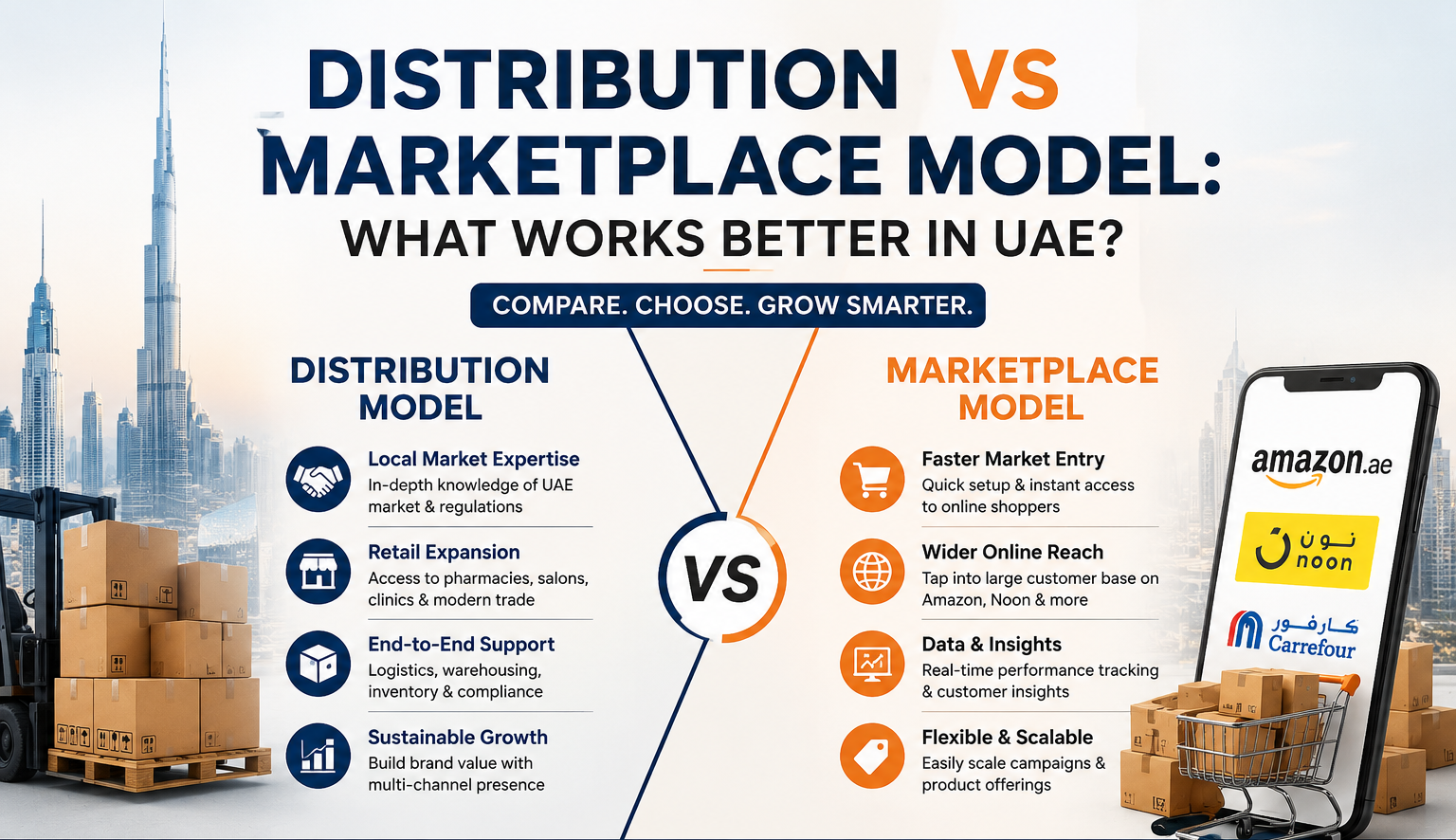
Distribution vs Marketplace Model: What Works Better in the UAE?
The UAE has established itself as one of the most attractive markets for international brands looking to expand across the Middle East. With a growing e-commerce sector, strong retail infrastructure, and consumers who actively seek premium international products, brands have multiple routes to enter the market. However, one of the most important decisions businesses face is choosing between a distribution model and a marketplace model.
While both approaches can help brands generate sales, they differ significantly in terms of market reach, operational requirements, scalability, and long-term growth potential.
Understanding the Distribution Model
A distribution model involves partnering with a local distributor who acts as an extension of your business within the UAE. The distributor typically manages product importation, warehousing, logistics, retailer relationships, marketplace operations, and market expansion strategies.
For international brands, this means gaining access to local expertise and established business networks without having to build an operational infrastructure from scratch.
Key Benefits of Distribution
Local Market Expertise
The UAE market has unique consumer preferences and purchasing behaviors. A local distributor understands these dynamics and can help brands position products effectively.
Retail Expansion Opportunities
Unlike a marketplace-only approach, distribution opens doors to multiple sales channels, including pharmacies, salons, clinics, specialty stores, supermarkets, and department stores.
Operational Support
Distributors handle inventory management, logistics, warehousing, and fulfillment, allowing brands to focus on product development and marketing.
Regulatory Compliance
For categories such as beauty, wellness, healthcare, and supplements, navigating local regulations can be challenging. A distributor can help ensure products meet relevant requirements and enter the market smoothly.
Understanding the Marketplace Model
The marketplace model enables brands to sell directly to customers through platforms such as Amazon UAE, Noon, Carrefour Online, and other e-commerce channels.
This approach is popular among brands looking for a relatively quick and cost-effective entry into the UAE market.
Key Benefits of Marketplace Selling
Faster Launch
Products can often be listed and sold more quickly compared to establishing a full retail distribution network.
Lower Initial Investment
Brands can begin selling without investing heavily in retail partnerships or extensive local infrastructure.
Direct Consumer Access
Marketplaces provide access to millions of active online shoppers and offer valuable insights into customer behavior, product performance, and demand trends.
Scalable Online Growth
With the right marketplace optimization and advertising strategy, brands can rapidly increase visibility and sales.
Distribution vs Marketplace: Which Delivers Better Results?
The answer depends on your business goals.
If your objective is to test demand, generate initial online sales, or launch products quickly, marketplaces can be an excellent starting point. They provide immediate visibility and access to a large customer base.
However, relying solely on marketplaces comes with limitations. Competition is intense, advertising costs continue to rise, and brands remain dependent on platform algorithms and policies. In addition, marketplace-only brands often struggle to establish a strong offline presence.
Distribution, on the other hand, creates a more diversified growth strategy. Instead of depending on a single sales channel, brands can expand across retail stores, pharmacies, salons, clinics, and e-commerce platforms simultaneously. This reduces risk and builds stronger brand recognition in the market.
Why Many Brands Choose a Hybrid Approach
In today’s UAE market, the most successful brands rarely choose one model exclusively. Instead, they combine both strategies.
Under a hybrid model:
- A distributor manages local operations and market expansion.
- Products are sold through major marketplaces to capture online demand.
- Retail partnerships help increase visibility and accessibility.
- Marketing efforts support both online and offline channels.
This approach allows brands to benefit from the reach of marketplaces while leveraging the expertise and infrastructure of a local distribution partner.
For beauty, wellness, healthcare, and personal care brands, this strategy often delivers the strongest results because consumers purchase products across multiple channels before becoming loyal customers.
Which Model Is Best for Your Brand?
A marketplace model may be the right choice if:
- You want to test the UAE market before making larger investments.
- Your focus is primarily online sales.
- You have the resources to manage inventory, logistics, and advertising independently.
A distribution model may be the better option if:
- You want long-term growth in the UAE and GCC region.
- You need access to retail and professional channels.
- You require support with logistics, compliance, and market expansion.
- You want to build a strong and recognizable brand presence.
Conclusion
Both distribution and marketplace models have a place in the UAE’s growing retail landscape. Marketplaces offer speed, convenience, and direct consumer access, while distribution provides the infrastructure, expertise, and channel diversification needed for sustainable growth.
For most international brands entering the UAE, particularly in beauty, wellness, healthcare, and consumer goods sectors, a distribution-led strategy supported by marketplace sales often delivers the best balance of visibility, scalability, and long-term success.
At Vivandi Distribution, we help international brands successfully enter and expand across the UAE through distribution, marketplace management, retail partnerships, logistics support, and growth-focused market strategies.
FAQs
What is the main difference between distribution and marketplace selling?
Distribution involves working with a local partner who manages operations and expansion, while marketplace selling focuses on direct online sales through e-commerce platforms.
Is marketplace selling enough to grow in the UAE?
It can generate sales, but brands often achieve stronger long-term growth by combining marketplace presence with retail distribution.
Why do international brands partner with distributors?
Distributors provide local expertise, operational support, retail access, and market knowledge that help brands scale faster.
Which model is better for beauty and wellness brands?
A distribution-led approach is often more effective because it supports both retail and online expansion while helping brands build credibility and visibility in the market.