


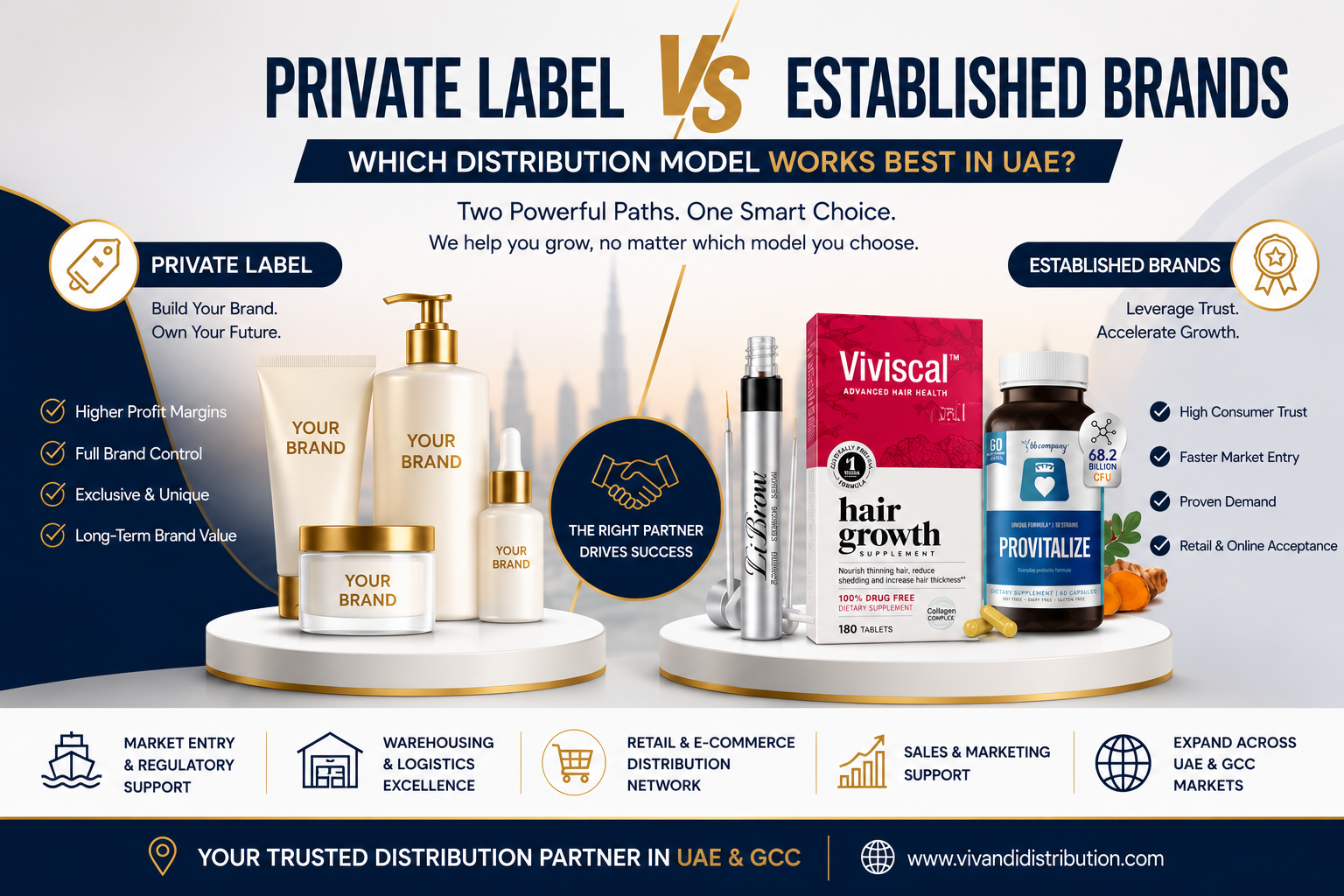
Private Label vs Established Brands: Which Distribution Model Works Best in the UAE?
The UAE has become one of the fastest-growing consumer markets in the Middle East, attracting international brands across beauty, wellness, healthcare, FMCG, and lifestyle categories. As businesses plan their expansion into the region, one question often arises:
Should you launch a private label product or distribute an established brand?
The answer depends on your business objectives, investment capacity, and long-term growth strategy. While both models have advantages, understanding their differences can help you choose the right path for success in the UAE.
If you’re looking for higher margins and full brand ownership, a private label model may be the right choice.
If your goal is faster market entry, stronger consumer trust, and quicker retail expansion, distributing an established brand is often the more effective strategy.
Many successful businesses in the UAE combine both models to diversify their portfolio and reduce market risk.
What Is a Private Label Brand?
A private label product is manufactured by one company but sold under another company’s brand name.
Businesses control:
- Branding
- Packaging
- Pricing
- Marketing
- Product positioning
Private label products are popular in categories such as skincare, personal care, supplements, and household products because they allow businesses to build their own brand identity.
Advantages of Private Label
- Higher profit margins
- Full control over branding
- Flexible pricing strategy
- Opportunity to build long-term brand equity
- Exclusive products with less direct competition
Challenges of Private Label
Launching a private label requires significant investment in product development, packaging, compliance, and marketing. Since consumers may not recognize a new brand, building trust often takes time and consistent marketing efforts.
What Are Established Brands?
Established brands already have market recognition, customer loyalty, and proven product performance. Consumers are generally more confident purchasing brands they know and trust.
Examples include premium beauty, wellness, and healthcare brands that have successfully expanded into international markets.
Advantages of Established Brands
- Higher consumer confidence
- Faster retail acceptance
- Proven product demand
- Easier marketing and promotion
- Lower brand awareness investment
Challenges of Established Brands
Businesses have less control over pricing and branding, and profit margins may be lower than private label products. Success also depends on maintaining strong relationships with the brand owner.
Private Label vs Established Brands: Comparison
| Factor | Private Label | Established Brand |
| Brand Recognition | Low initially | High |
| Market Entry Speed | Moderate | Fast |
| Marketing Investment | High | Moderate |
| Customer Trust | Takes time | Immediate |
| Profit Margins | Higher | Moderate |
| Brand Ownership | Complete | Limited |
| Retail Acceptance | Slower | Faster |
| Long-Term Brand Value | High | Shared with brand owner |
Which Model Works Better in the UAE?
The UAE consumer market values quality, authenticity, and trusted brands. In categories such as beauty, wellness, healthcare, and premium consumer products, established brands often gain traction more quickly because shoppers are already familiar with their reputation.
However, private label products continue to grow as retailers and businesses invest in exclusive product ranges that offer competitive pricing and differentiation.
For many companies, the ideal strategy is not choosing one over the other—it is selecting the model that aligns with their goals.
Choose Private Label If You Want To:
- Build your own brand
- Control pricing and packaging
- Create exclusive product lines
- Invest in long-term brand equity
Choose Established Brands If You Want To:
- Enter the UAE market quickly
- Leverage existing consumer trust
- Expand through retail and e-commerce channels
- Reduce time spent building brand awareness
Why Distribution Matters More Than the Brand Model
Whether you launch a private label or distribute an established brand, success in the UAE depends on having the right distribution strategy.
A local distribution partner can help with:
- Market entry planning
- Import and logistics
- Warehousing
- Retail placement
- Marketplace management
- Sales support
- Marketing activation
- GCC expansion
An experienced distributor understands local consumer behaviour, retailer expectations, and regulatory requirements—making it easier for brands to scale efficiently.
Final Thoughts
Both private label and established brands can succeed in the UAE when backed by the right strategy.
Private label offers greater control and long-term brand ownership, while established brands benefit from consumer trust and faster market penetration. Businesses should evaluate their budget, growth objectives, and operational capabilities before deciding.
At Vivandi Distribution, we help international brands navigate the UAE market through strategic distribution, retail expansion, marketplace management, and end-to-end market entry solutions. Whether you’re launching a private label or expanding an established brand, the right distribution partner can accelerate your growth.
Frequently Asked Questions
Is private label profitable in the UAE?
Yes. Private label products can deliver strong margins, particularly when supported by effective branding and distribution.
Do established brands sell better than private label products?
Established brands often gain faster consumer trust, while private label products can build long-term value with the right marketing strategy.
Which industries are best for private label in the UAE?
Beauty, skincare, wellness, supplements, personal care, and FMCG categories are among the strongest private label opportunities.
How can international brands enter the UAE market?
Partnering with an experienced local distributor is one of the most effective ways to manage logistics, retail expansion, compliance, and market growth.